
Framework at a Glance
The DKU Teaching and Mentoring Effectiveness Framework (TMEF) is a faculty-developed articulation of effective teaching and mentoring in DKU’s distinctive educational context. It identifies six interconnected dimensions of effective teaching(Align, Include, Engage, Assess, Reflect, and Technology Choices) and five key functions of effective mentoring and advising (Guide, Empower, Connect, Cultivate,and Clarify). Together, they provide a shared vocabulary for understanding, evaluating, strengthening, and recognizing teaching and mentoring effectiveness across disciplines. While teaching and mentoring have distinct contexts and purposes, the principles underlying effective teaching also inform and apply to mentoring and advising.
Align and Reflect form the continuous thread of effective teaching and mentoring, supporting an iterative process of intentional design, implementation, evaluation, and improvement. Within this ongoing cycle, Include, Engage, Assess, and Technology Choices work as an integrated system rather than a checklist of discrete practices. They may overlap and operate simultaneously, with decisions in one often shaping or informing others.
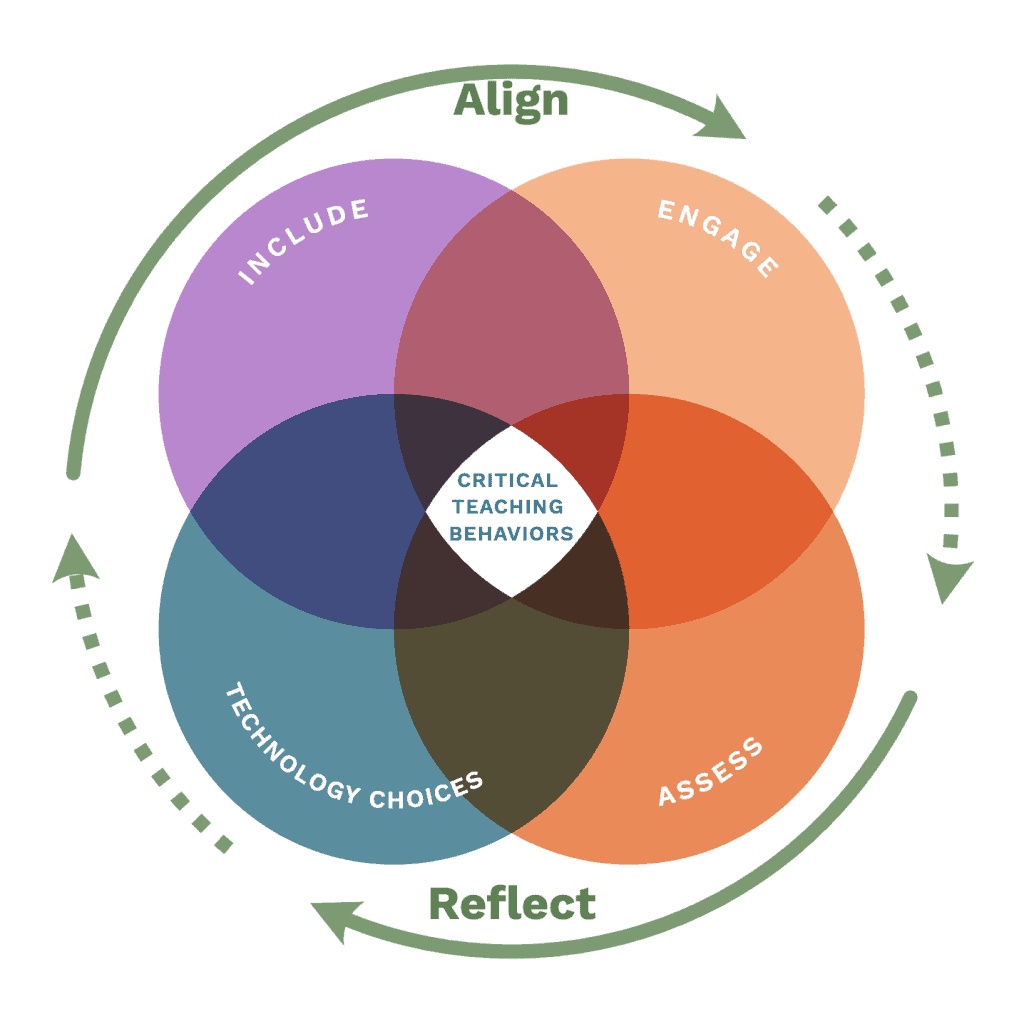
TEACHING EFFECTIVENESS
Teaching Effectiveness: 6 Dimensions
ALIGN: Connect goals, activities, and assessment
Instructors align components of learning experiences with clear learning goals. Measurable outcomes, teaching and learning activities, assessments, and feedback build on each other to support student progress towards learning goals.
- AL.1 If teaching an existing course: Apply all officially approved learning outcomes without modification, adding only 1–2 if needed. If designing a brand-new course: Connect course learning outcomes to major, interdisciplinary, institutional, and accreditation expectations as appropriate, demonstrating awareness of the curricular context.
- AL.2 Select learning activities that support the LOs at levels of engagement and challenge appropriate to the course and discipline.
- AL.3 Adapt pedagogies to fit the course design and curriculum context.
- AL.4 Deliver assessments as designed and prepare students accordingly, especially for major assignments that count more than 25% of the grade.
- AL.5 Emphasize connections of course concepts and skills across lessons, learning units, and courses in the curriculum (e.g., prerequisites and upper-stream courses).
INCLUDE: Foster belonging for learning
Instructors create an inclusive learning environment to promote equity by using accessibility standards and learner-centered strategies. They cultivate an atmosphere in which students see themselves positively represented and experience a sense of belonging conducive to emotional well-being for learning.
- IN.1 Builds community and fosters trust with and among students, appropriate to class size and structure.
- IN.2 Supports student success by connecting them to needed resources inside and outside class.
- IN.3 Uses learner-centered strategies that support student engagement while maintaining alignment with approved learning outcomes.
- IN.4 Select materials and activities that reflect diverse perspectives and experiences relevant to the discipline and student population.
- IN.5 Remove barriers to success by designing activities and materials with equitable access and representation in mind, within the scope of the instructional role.
- IN.6 Reflect on personal biases and actively manage their impact on student learning, recognizing that productive discomfort can be part of multicultural learning.
ENGAGE: Empower students do the intellectual work
Instructors select research-based techniques to ensure that students actively participate in the learning process and take responsibility for their intellectual development.
- EN.1 Design course activities to intentionally promote academic connections (e.g., student-instructor, student-content, student-student and student-community engagement).
- EN.2 Encourage participation of all students by using varied instructional strategies.
- EN.3 Relate course content to relevant examples and application.
- EN.4 Foster self-regulated learning.
- EN.5 Maintain regular on-campus presence, host in-person office hours, and offer consistent, accessible communication with students.
- EN.6 Incorporate current research in the field to stimulate discipline-specific critical thinking and engage students in research-related activities or opportunities.
ASSESS: Provide feedback to move learning forward
Instructors develop and facilitate transparent, aligned, meaningful assessments to provide students with timely feedback on their learning and to measure achievement and progression toward learning outcomes. They frequently review a range of assessment data to improve instruction.
- AS.1 Schedule multiple assessment opportunities across the 7-week term, rather than one or two high-stakes ones, to measure student progress towards learning outcomes.
- AS.2 Include assessments that provide feedback and support student reflection while tracking learning progress.
- AS.3 Scaffold assessments throughout the course.
- AS.4 Communicate purpose, task, and criteria for assessments.
- AS.5 Provide timely, constructive feedback and support students in using it to guide their learning and improvement.
- AS.6 Review assessment findings to make informed decisions about course content, structure, and activities.
REFLECT: Approach teaching as an iterative practice
Instructors gather and reflect on their teaching from self-assessment, peers, and students to regularly identify opportunities for growth and engage in ongoing professional development opportunities available at and beyond DKU.
- RE.1 Engage in and document reflective self-assessment of teaching.
- RE.2 Invite feedback on teaching from colleagues.
- RE.3 Solicit and integrate student feedback.
- RE.4 Engage with scholarship and professional development related to teaching.
- RE.5 Plan for professional development as a teacher by identifying areas for development and setting goals.
- RE.6 Experiment with alternative pedagogical approaches where necessary or appropriate.
TECHNOLOGY CHOICES: Make intentional choices about technology use
Instructors make intentional, pedagogically informed decisions to calibrate the use of technology (including AI and emerging technologies) in ways that optimize the learning experience and enhance the core value of learning.
- TC.1 Make intentional choices about whether, when, and how technology can meaningfully support intended learning goals.
- TC.2 Leverage technology strategically to enhance and personalize learning, augment human capacities, promote access and equity, and create learning opportunities and experiences beyond traditional barriers of space, time, and resources.
- TC.3 Use technology effectively, efficiently, and responsibly, with appropriate support for students when technology is integrated into learning activities.
- TC.4 Ensure technology-enabled materials, tools, and practices meet relevant legal, ethical, and institutional requirements.
TC.5 Intentionally minimize or restrain the use of technology when it may distract, diminish, or add limited value to the intended learning goals.
Mentoring & Advising Effectiveness: 5 Functions
GUIDE students' academic and career navigation
EMPOWER student agency
CONNECT students to academic and professional opportunities and institutional resources
CULTIVATE trusting and supportive mentoring relationship
CLARIFY expectations for responsibilities, processes, communication, and professional boundaries
MENTORING & ADVISING EFFECTIVENESS